
What is Cost-Volume-Profit (CVP) analysis?
CVP Analysis
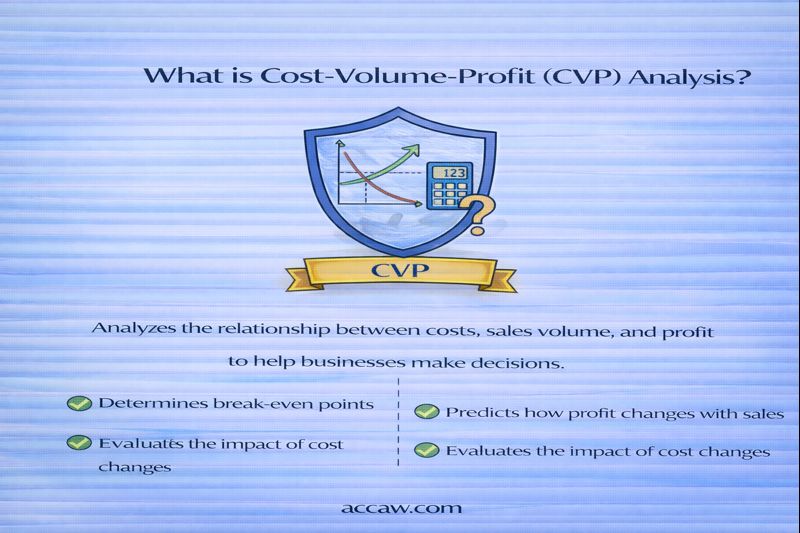
What is Cost-Volume-Profit (CVP) analysis?
Summary: Cost-Volume-Profit (CVP) Analysis is a managerial accounting technique that examines the relationships between costs (fixed and variable), volume (units sold or produced), and profit. Its core components include: Contribution Margin (Sales - Variable Costs), Break-Even Point (where profit = 0), Target Profit Analysis, Margin of Safety, and Operating Leverage. CVP helps in planning, decision-making, and understanding the profit structure of a business.
The Map to Profitability
CVP analysis answers fundamental business questions: "How many units do we need to sell to break even?" "What profit will we make if we sell X units?" "How will a change in price or cost affect our profit?" It simplifies complex reality into a powerful, usable model.
1. Foundational Concepts and Assumptions
Key Assumptions of Basic CVP:
- Costs can be accurately separated into fixed and variable components.
- Fixed costs remain constant in total within the relevant range.
- Variable costs per unit are constant.
- Selling price per unit is constant.
- Sales mix (proportion of multiple products sold) remains constant (in multi-product firms).
- Inventory levels do not change significantly (production = sales).
These assumptions allow for linear relationships, making the analysis manageable.
2. Core Components and Formulas
A. Contribution Margin (CM)
The amount from each sale that contributes to covering fixed costs and then generating profit.
CM per unit = Selling Price per Unit - Variable Cost per Unit
Total CM = Total Sales Revenue - Total Variable Costs
Contribution Margin Ratio (CMR) = CM per unit / Selling Price = Total CM / Total Sales
B. Break-Even Point (BEP)
The sales level (in units or dollars) where Total Revenue = Total Costs, and profit is zero.
BEP in Units = Total Fixed Costs / CM per Unit
BEP in Sales Dollars = Total Fixed Costs / CMR
C. Target Profit Analysis
Sales needed to achieve a specific profit target.
Units for Target Profit = (Fixed Costs + Target Profit) / CM per Unit
Sales $ for Target Profit = (Fixed Costs + Target Profit) / CMR
D. Margin of Safety
The cushion between actual/budgeted sales and break-even sales. Measures risk of a loss.
Margin of Safety in Dollars = Actual (Budgeted) Sales - Break-Even Sales
Margin of Safety % = (Margin of Safety in Dollars / Actual Sales) × 100%
E. Operating Leverage
A measure of how sensitive net operating income is to a percentage change in sales. High fixed costs = high operating leverage.
Degree of Operating Leverage (DOL) = Contribution Margin / Net Operating Income
% Change in Net Income = % Change in Sales × DOL
3. Comprehensive Example
Company Data: Selling Price = $100/unit. Variable Cost = $60/unit. Fixed Costs = $200,000.
Calculations:
CM per unit = $100 - $60 = $40. CMR = $40 / $100 = 40%.
BEP in Units = $200,000 / $40 = 5,000 units.
BEP in $ = $200,000 / 0.40 = $500,000.
Target Profit of $80,000: Units = ($200,000 + $80,000) / $40 = 7,000 units.
If Actual Sales are $700,000: Margin of Safety $ = $700,000 - $500,000 = $200,000. Margin of Safety % = $200k / $700k = 28.6%.
At $700,000 sales: Net Income = ($700k × 0.40) - $200k = $80,000. DOL = ($700k × 0.40) / $80k = $280k / $80k = 3.5.
A 10% increase in sales → 35% increase in net income (10% × 3.5).
4. Applications in Decision-Making
- Pricing Decisions: What price is needed to achieve a target profit at an expected volume?
- Cost Structure Decisions: Choosing between a high-fixed-cost (automated) vs. high-variable-cost (manual) process. The automated option has a higher BEP but higher profits beyond that point.
- "What-If" Scenarios: Impact of changes in price, costs, or volume on profit.
- Marketing Campaigns: Will a proposed ad campaign (increase in fixed costs) generate enough additional sales (volume) to be profitable?
- Setting Sales Commissions: Structuring commissions based on contribution margin.
5. Multi-Product CVP and Limitations
For multiple products, use a weighted-average contribution margin based on the expected sales mix. The main limitation is the reliance on linear assumptions, which may not hold in the real world (e.g., volume discounts, step-fixed costs).
6. Conclusion: The Profit Planner
CVP analysis is an indispensable tool for profit planning and sensitivity analysis. By clarifying the relationships between costs, volume, and profit, it empowers managers to make informed decisions about pricing, product mix, cost control, and growth strategies. It provides a simple yet powerful framework for navigating toward profitability.